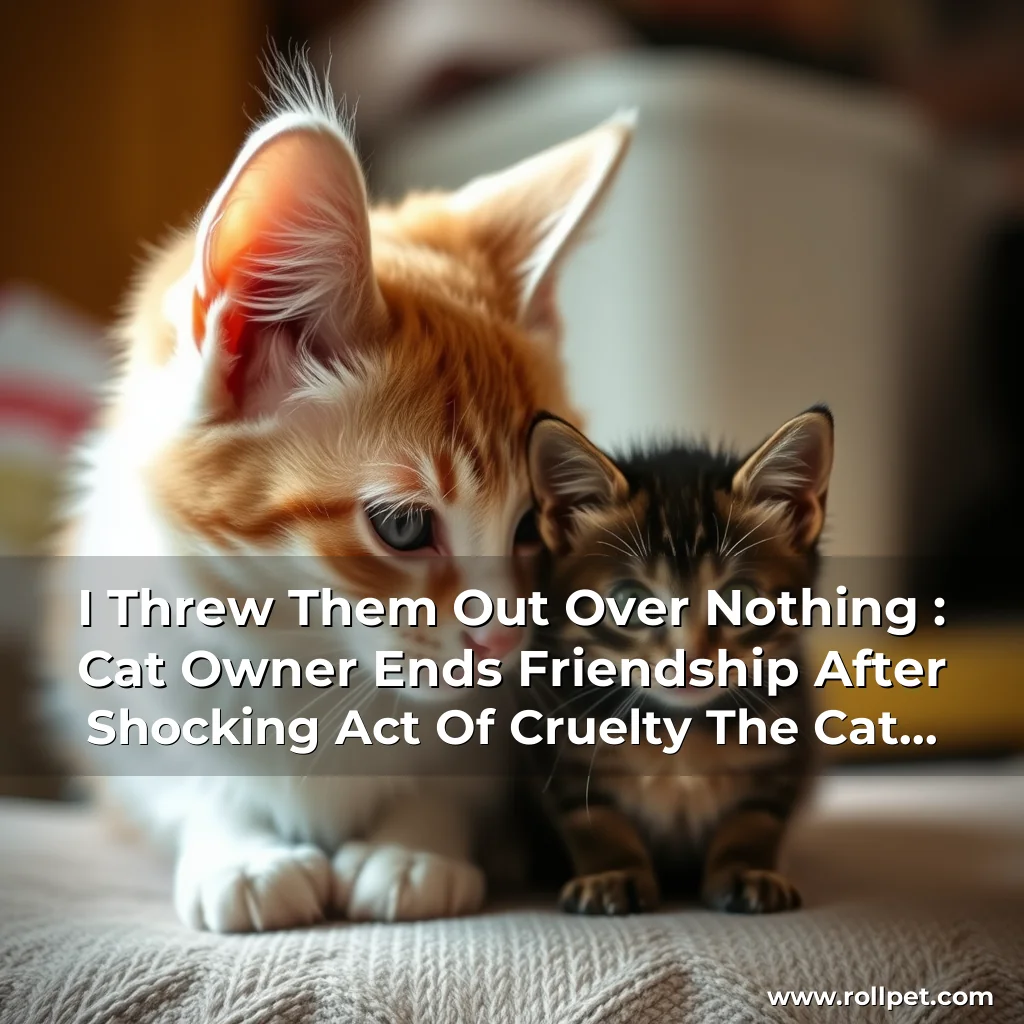
Delgado, who has been working with cats for over 20 years, shared some valuable insights on what happened and why it’s so important to prioritize cat safety. According to Delgado, cats are naturally more sensitive than dogs when it comes to physical contact and touch. This sensitivity is largely due to their evolution as solitary hunters. In the wild, cats are often forced to fend for themselves and can’t rely on their human family for protection. As a result, they tend to be more cautious and less trusting of strangers. When a cat is touched or handled roughly, it can be perceived as a threat, leading to fear and anxiety. This sensitivity is not limited to physical touch, but also extends to handling and restraint. Cats are naturally more inclined to hide and seek seclusion when they feel threatened or uncomfortable. They use their agility and flexibility to escape and find safety. In this case, the cat parent’s skittish kitty was likely overwhelmed by the sudden and forceful movement, leading to its attempt to flee. The cat’s reaction was a natural response to the perceived threat, and it’s essential to respect and acknowledge this. Moreover, cats have a unique way of communicating their boundaries and needs. They use body language and vocalizations to convey their feelings and intentions. If a cat is uncomfortable or stressed, it may display behaviors such as flattening its ears, tail twitching, or hissing. These cues are essential for cat owners to recognize and respond to appropriately. In this situation, the cat parent’s friend failed to recognize the cat’s distress signals, leading to the cat’s frightened response. To prioritize cat safety, it’s crucial to understand and respect the cat’s boundaries and needs.
Genetics play a significant role in shaping a cat’s personality, but it’s not the only factor.
This window is typically considered to be between 2-14 months of age, during which time kittens are most receptive to new sights, sounds, and experiences.
Positive experiences during socialization can have a lasting impact on a cat’s behavior and personality. Cats that receive positive reinforcement and rewards for calm behavior are more likely to generalize this behavior to new situations.
Overcoming Shyness and Fear
Cats that are skittish or fearful may require more time and effort to overcome their shyness.
In many cases, it is simply a feline behavior that can be explained by its natural instincts.
If your cat is not comfortable with visitors, it’s not a problem.
Cats are the second most popular pet, with 42.9 million households owning one.
These benefits can be attributed to the unique bond that forms between a pet and their owner.
This is because children are more impressionable and vulnerable to the influence of their caregivers. The Impact of Animal Cruelty on Children The effects of animal cruelty on children can be far-reaching and devastating. Children who witness or experience animal cruelty are more likely to develop aggressive behavior, anxiety, and depression. This is because children learn by observing and imitating the behavior of those around them, including their caregivers. • Children who witness animal cruelty may also develop a sense of helplessness and powerlessness, which can lead to feelings of anger and frustration. • Furthermore, children who are exposed to animal cruelty may also develop a negative perception of animals, which can lead to a lack of empathy and compassion for all living beings.
State-Specific Laws
Each state has its own unique set of laws and regulations regarding animal cruelty. While some states have more comprehensive laws, others have more limited protections. Here are a few examples of state-specific laws:
Some states have increased penalties for pet cats versus unowned cats. For example:
Some states have increased protections for unowned cats versus pet cats.
Further details on this topic will be provided shortly.

news is a contributor at Roll Pet. We are committed to providing well-researched, accurate, and valuable content to our readers.